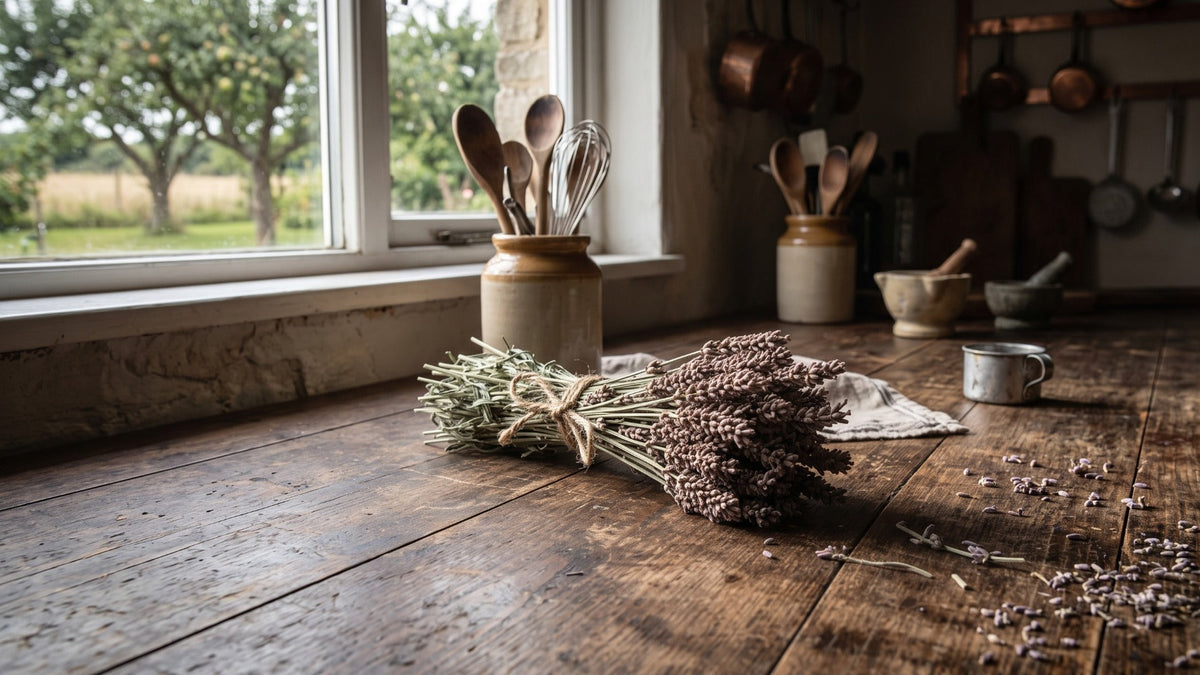
Lavender is the oil most people buy first, and the one most often used badly. It is also the oil with the widest gap between what it is supposed to smell like and what most bottles actually smell like.
What lavender actually smells like
Good lavender is not sweet. The sweet, soapy, faintly purple thing most people picture is what lavender smells like in fabric conditioner, and it is usually not lavender at all.
The oil itself is drier than that. Herbal first, almost green, with something camphorous underneath that reads as clean rather than floral — closer to a cut stem than to a flower. It is quieter than you expect, and it fades in a way that feels deliberate rather than sudden.
If a bottle smells sweet and thick and stays that way for hours, it is worth asking what is in it.
Lavender oil in a diffuser
This is the obvious use and the one it suits best, because lavender is forgiving. A few drops too many will not overwhelm a room the way a resin or a citrus will — it thins out rather than turning sharp.
Two or three drops is plenty for a bedroom. In an ultrasonic diffuser it arrives gently and spreads slowly, which is the behaviour most people want from lavender in the first place. The four kinds of diffuser handle it differently, and the difference is more noticeable with lavender than with almost anything else, because so much of what makes it pleasant lives in the lighter molecules that leave first.
Lavender as a room freshener
Lavender is the oil that does best in the space between rooms — hallways, landings, the corner of a room nobody sits in. It does not announce itself, which is exactly why it works where a stronger scent would feel staged.
Practically: a drop on an unglazed dish, a cotton pad behind a shelf, or a few drops in the water when floors are washed. It holds for a day or two on a porous surface and a few hours in open air.
Lavender oil uses in a wardrobe and on linen
This is where lavender has been used for the longest, and where a very small amount goes furthest. Enclosed spaces have no draught to carry scent away and nowhere for it to disperse to.
Dry, faintly herbal, closer to clean linen than to flowers — that is the register lavender occupies in a cupboard, and it is the reason it has survived in this use for centuries while fashions in fragrance moved on. A cotton pad with a few drops, tucked at the back of a shelf, is still noticeable a fortnight later.
Indian households have a long parallel tradition here with neem and camphor. The principle is the same; the material is different. There are more of these household uses than most people expect.
Lavender oil uses for hair
Lavender turns up constantly in hair oils, almost always diluted — a few drops in a carrier such as coconut, almond or sesame oil, worked through the scalp. It is very often paired with rosemary, which is one of the most searched combinations in the category.
What it does there is a question for a dermatology reference rather than for a brand, and we would rather point you at one than tell you ourselves. What can be said plainly is how it is used: diluted, in small amounts, in a carrier — never neat.
The scent is part of the appeal. A scalp oil sits close to the head for hours, so a heavy fragrance becomes tiring quickly. Lavender is one of the few that stays pleasant at that distance.
Lavender oil uses for skin
The same rule applies and matters more. Essential oils are concentrated, and standard practice is to dilute them in a carrier before contact with skin — a small percentage, not drops applied neat.
Patch testing a small area first is ordinary practice, not excessive caution, and some oils cause reactions more readily than others. A dermatology source will tell you more about which than any brand will.
Why one lavender oil costs more than another
Most of the price difference is species, not quality claims.
True lavender (Lavandula angustifolia) grows at altitude, yields less oil per plant, and produces the softer, rounder scent most people mean when they say lavender.
Lavandin (Lavandula × intermedia) is a hybrid. It grows lower, yields far more, and carries noticeably more camphor — sharper, more medicinal, and much cheaper. It is what scents most detergents and cleaning products, entirely legitimately.
Both are lavender. They are not interchangeable, and a bottle that does not say which one it is has told you something. The other honest variables are extraction method, the age of the oil, and how it has been stored — citrus and lighter oils oxidise fastest, and lavender is not far behind.
What will damage something
Lavender is among the gentler oils, but it is still a solvent.
Varnished, polished or lacquered wood. It will cloud a finish and lift a lacquer, and the mark does not come out.
Fabric you care about, undiluted. Even oils that look clear can leave a ring. Test on a hem.
Skin, undiluted. Dilute in a carrier, patch test first, and read a dermatology reference rather than a brand on which oils are more likely to cause a reaction.
Around cats. Several oils that are unremarkable for people are a genuine problem for cats, whose livers process them differently. This is a question for a vet.
A note on quantity
Lavender rewards restraint more than most oils, because its pleasure is in the fade rather than the arrival. Two drops in a small room is a different experience from six — not a weaker one.
Start with less than feels like enough. Most of the good methods need nothing you do not already own.
SoulSoil oils are cosmetic products, not medicines. Articles here are general and editorial, are not medical advice, and are not a substitute for professional care. If you have a health concern, speak to a doctor.