Almost every seasonal guide to scent is written for a Northern Hemisphere year — pine and cinnamon in December, something citrus in a short summer. Very little of it survives contact with an Indian one.
What follows is a rough shape rather than a rule. A flat in Mumbai in July has different problems from a house in Shimla in January.
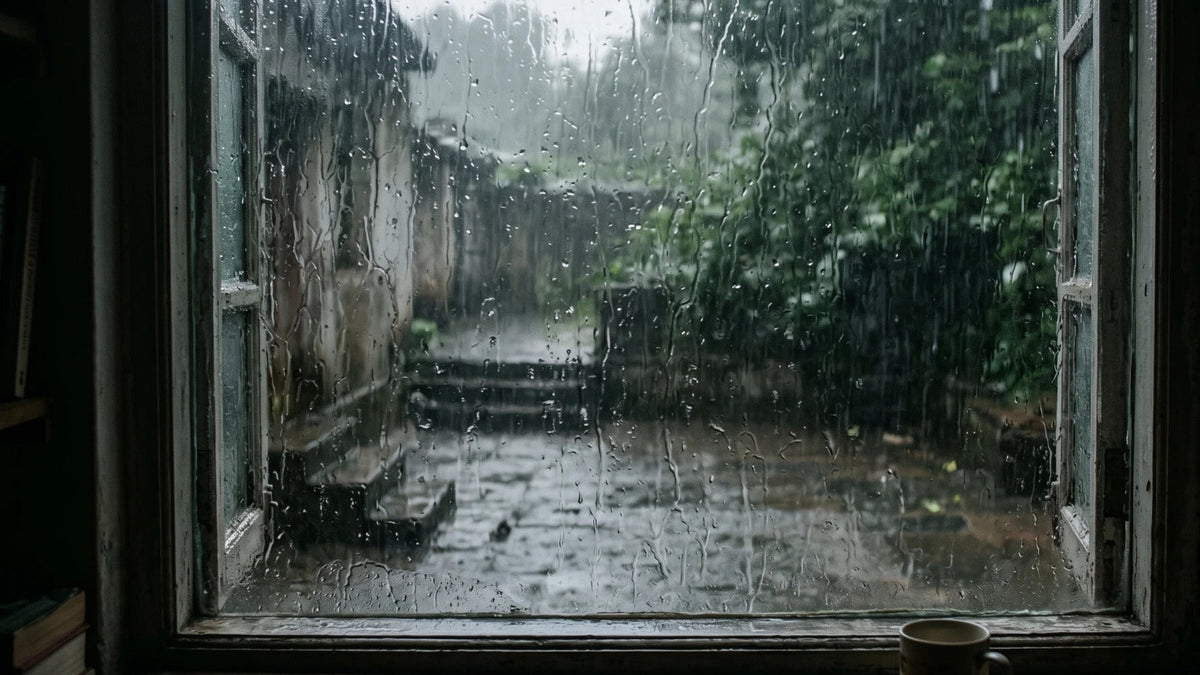
Monsoon
The season that makes the strongest case for scent in a home, and for the least romantic reason: damp.
Cupboards stay shut, air stops moving, and everything from shoe racks to bedding takes on the particular flatness of a room that has not dried out in weeks. This is when enclosed spaces matter most — wardrobes, drawers, storage under beds, the cupboard where the umbrellas live.
Bright, sharp scents cut through humidity better than heavy ones. Lemongrass and eucalyptus read as clean in wet air. Sweeter, denser scents can feel cloying when the air is already saturated.
Practically: open a window on the rare dry hour, and treat the enclosed spaces rather than the open ones. Scent will not fix damp. It sits alongside airing, not instead of it.
Summer
Heat makes everything volatile evaporate faster. The same number of drops will arrive stronger and disappear sooner — which means less, not more.
Lighter scents suit hot rooms. Citrus and grassy notes feel appropriate at forty degrees in a way that resins and heavy woods do not. Anything warm and sweet can feel oppressive.
A practical note that has nothing to do with fragrance: store bottles out of the heat. A cupboard on an exterior west-facing wall in May is a bad place for an oil, and citrus oils in particular will turn.
Winter
In the north, this is the one season where the Northern Hemisphere writing roughly applies. Closed windows, slower air, and rooms that hold a scent for hours rather than minutes.
Warmer and rounder scents come into their own. Quantities can drop again — a closed room in January needs a fraction of what the same room needs with the windows open in October. This is also the season where the difference between one kind of diffuser and another is most noticeable, because the room holds whatever you put into it.
In much of the south and west, winter is mainly a relief from heat rather than a distinct scent season, and summer habits carry through with less urgency.
Festival cleaning
The deep clean before Diwali is the single most scent-attentive week in the Indian domestic year, and it is a genuinely good moment for this — not because of ritual significance, but because everything is already pulled out, wiped down and put back.
Cupboards are empty. Linen is being folded. Floors are being washed anyway. Anything you want to scent for the next few months is accessible exactly once, and it costs almost nothing to do it while the doors are already open.
A general principle
The mistake in every season is treating scent as decoration applied on top of a room. It works better as a response to what a room is actually doing — humid, hot, shut up, aired out, full of people, empty all day.
Notice the room first. The choice tends to follow.
SoulSoil oils are cosmetic products, not medicines. Articles here are general and editorial, are not medical advice, and are not a substitute for professional care. If you have a health concern, speak to a doctor.